

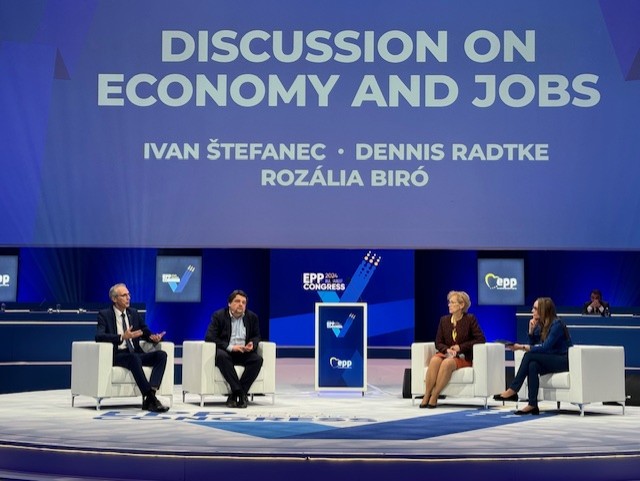
This resolution on Financing Public investment in the EU: The need for an EU investment” was tabled by European Union of Christian Democratic Workers (EUCDW) and adopted by the resolution committee of 26 March 2025 and of 9 April 2025. See the full resolution below the picture.
The EU finds itself at a crossroads. The certainties of the recent past seem to disappear at a fast speed: the geopolitical order and international rules installed after WW II – a world where the advantages of free trade were recognized very broadly – culminating in the establishment of the WTO, peace in Europe guaranteed by a strong NATO. The Covid and energy crises showed that the EU must diminish its dependency on countries or economic blocs considered as global competitors. To tackle these challenges, the EU must integrate more deeply, both economically and politically, to better align various policies[1] and enhance its impact on the global scene by transforming its economic weight into political influence.
Succeeding in the triple transition (climate, digital and demographic) is a precondition for enhancing our autonomy. This requires significant investments efforts, some of which must come from the public sector. The EU and its Member States must provide the finance necessary to meet these public investment needs.
The Draghi Report sets out the main objectives of a new industrial strategy for Europe: closing the innovation gap, draft a plan for decarbonization and improving competitiveness to reduce energy prices and use foreign economic policy to enlarge security and reduce dependency. Among the building blocks for a new industrial strategy is finance. The report estimates that 5% of GDP is needed for financing the necessary investments, 80% of which must be financed by private capital and 20% by public funding, representing 1% of EU GDP or €170billion per year.
Member States should promote investment spending that produces a positive rate of return, while public investment will also play a catalysing role. This is the case for major infrastructure projects (e.g., electric connectivity, high-speed-railways), for boosting innovation in future technologies (e.g., AI infrastructure), for stimulating the energy transition by supporting companies to become carbon-neutral and preserve our critical energy-intensive industry during the transition period, and for reshoring critical industries such as pharmaceuticals, mining and processing of critical raw materials. Public money is also needed for investment in research, innovation and education. Not only to enhance the quality of the former, but also to make sure that the investments are in line with the bigger principles of Europe and its existence. Given that the majority of investment will come from the private sector, completing the Capital Markets Union and Banking Union, as well as redirecting expenditure to the most efficient level, remain key priorities.
The new fiscal rules offer greater flexibility and incentives for investments and national reforms needed to tackle the EU’s economic, social, and geopolitical challenges. They extend the adjustment period to seven years and exempt all national co-financing in EU-funded programs from the expenditure rule.The existing EU Multiannual Financial Framework and other EU financial instruments do not provide sufficient fiscal room for this public investment need. We acknowledge efficiency gains that may stem from the provision of European public goods at EU scale through the effective coordination of investment priorities among Member States. The Recovery and Resilience Fund ends in 2026 and repayment of the NGEU bonds will start in 2028. This framework, where appropriate, should be strengthened by EU-level investment instruments and tools designed to minimize the cost for EU taxpayers and maximize efficiency in the provision of European public goods, taking into account the mistakes from the Recovery and Resilience Facility and after a careful analysis of its economic impact. We call to effectively evaluate ex post the impact of agreed investments and reforms in terms of supporting fiscal sustainability, enhancing the growth potential of the economy, addressing the EU’s common priorities and the Country Specific Recommendations and ensuring the required level of nationally financed public investment. The next MFF must also help to preserve the level playing field of the single market and because projects which could be supported must align in an EU-wide industrial- transition strategy.
The financial instruments to be used by EU Investment instrumental and tools could consist of low interest loans, guarantees, targeted subsidies and public equity investments. Close cooperation with the EIB and national financial institutions is desirable to enhance leverage and involve their expertise. The use of these financial instruments must be streamlined and spent based on European public goods, taking into account experiences with NextGenerationEU and the EU Recovery and Resilience Facility.
The investment instrument and tools have to match the increased funding necessities. EU investment instruments and tools should be proposed after a careful consideration of real financial needs.
[1] e.g. industrial, trade and competition policy
Others News & Publications
Aut provident eligendi nam odio animi hic similique saepe et iure rerum
in quia ipsam ab facilis repellat. Quo consequatur voluptas qui voluptatem
saepea labore quia vel odio fugiat id tempore rerum.